
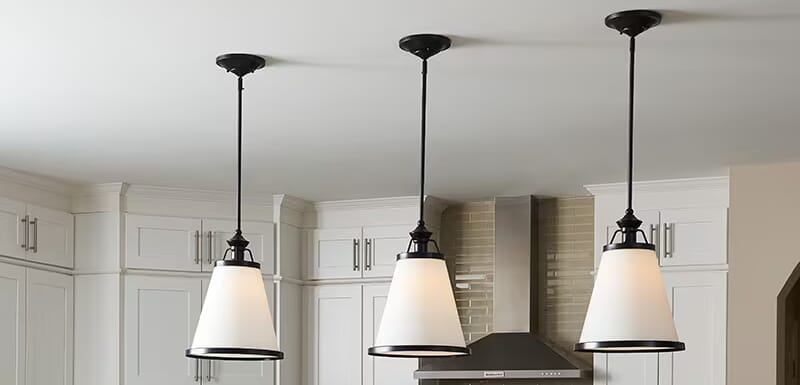
What Size Pendant Light Do I Need?
The right pendant light size depends on where you’re installing it, the dimensions of your space and whether you’re using one pendant or multiple fixtures. As a general rule, larger spaces can accommodate larger pendants, while smaller areas benefit from more compact designs. However, the size of the surface beneath the pendant is just as important as the overall room dimensions.
How Do I Measure Pendant Light Size?
Pendant light size is typically described by its diameter or width, measured across the widest part of the fixture. For example, a 12-inch pendant measures approximately 12 inches across, while a 24-inch pendant has a much larger visual presence.
When comparing pendants, pay attention to three key measurements:
- Diameter or width: How much horizontal space the pendant occupies.
- Fixture height: The vertical height of the pendant itself, excluding its hanging chain, cord or downrod unless otherwise specified.
- Overall hanging height: The total distance from the ceiling to the bottom of the installed fixture, including its mounting hardware and suspension.
These measurements help determine whether a pendant will fit comfortably in your space and hang at the appropriate height.
Pendant Light Size Chart by Location
Use this chart as a starting point when choosing pendant lighting for common areas of your home.
| Location | Suggested Pendant Size |
| Small kitchen island or peninsula | 8 to 12 inches per pendant |
| Medium to large kitchen island | 12 to 20 inches per pendant |
| Dining table with one pendant | Approximately one-half to two-thirds of table’s width |
| Bedside pendant | 6 to 12 inches per pendant |
| Entryway or foyer | Varies based on room dimensions and ceiling height |
These are general design guidelines, not fixed requirements. The ideal pendant size depends on the number of fixtures, their shape and visual weight, and the available clearance.
How Do I Choose the Right Pendant Size for My Room?
Start by considering the pendant’s purpose. A single oversized pendant can create a striking focal point above a dining table or in an entryway, while a series of smaller pendants can provide balanced illumination across a kitchen island.
Next, think about visual proportion. Pendants with open frames or clear glass shades often feel lighter and less imposing than solid metal or opaque designs of the same diameter. This means two pendants with identical measurements can look very different once installed.
Finally, consider the surrounding furniture and architectural features. A pendant should complement the scale of the space without overwhelming nearby cabinets, furniture or other fixtures.
The key takeaway: Choose a pendant size that suits both your space and its purpose. Use the measurements above as a starting point, then consider the number of pendants, their hanging height and the overall look you want to achieve.
How Many Pendant Lights Do I Need Over a Kitchen Island?
The number of pendant lights you need over a kitchen island depends on the island’s length, the size of the pendants and the look you want to achieve. Most kitchen islands work well with two or three pendant lights, although a single oversized pendant or a row of four smaller fixtures may be a better fit for certain spaces.
Larger pendants generally require fewer fixtures while smaller pendants can be arranged in groups to provide balanced lighting across the island.
How Many Pendants Do I Need for My Island Size?
Use this chart as a starting point when deciding how many pendant lights to hang over your kitchen island.
| Kitchen Island Length | Suggested Number of Pendants |
| 4 feet | 1 or 2 pendants |
| 5 feet | 2 pendants |
| 6 feet | 2 or 3 pendants |
| 7 feet | 2 or 3 pendants |
| 8 feet | 2 or 3 pendants |
| 9 feet or longer | 3 or 4 pendants |
These recommendations are general guidelines. The ideal number of pendants depends on fixture diameter, spacing, island layout and the amount of light needed.
Should I Hang Two or Three Pendant Lights Over My Kitchen Island?
Both arrangements can work beautifully! The best choice depends on the size and visual impact of your pendants.
Two pendant lights are often a great option for medium to large islands, especially when using substantial fixtures with wider shades. This arrangement creates a balanced, uncluttered look while allowing each pendant to make a statement.
Three pendant lights can work well when using smaller fixtures or when you want a more evenly distributed row of light across a longer island. Three pendants can also create a sense of rhythm and symmetry, particularly in kitchens with traditional or transitional designs.
Don’t feel limited by the idea that pendant lights must be installed in odd numbers. Two larger pendants can look just as balanced as three smaller ones.
Can I Hang Just One Pendant Over a Kitchen Island?
Absolutely! A single oversized pendant can be an eye-catching choice over a compact kitchen island, especially when the fixture provides enough light for the surface below.
For longer islands, a linear pendant or multi-light island fixture may offer better coverage than one traditional pendant. These fixtures combine multiple light sources into one design, creating a streamlined look without requiring several individual pendants.
Can I Hang Four Pendant Lights Over a Kitchen Island?
Yes! Four pendant lights can work well over especially long islands, particularly when the fixtures are relatively small.
However, adding more pendants isn’t always better. Too many fixtures can make a kitchen feel crowded, especially if the pendants have large shades or substantial decorative details.
Before choosing four pendants, consider whether three larger fixtures or a linear pendant would provide a more balanced look.
The key takeaway: Start with your island’s length, then consider the diameter and visual weight of your preferred pendants. The goal is to create balanced lighting and comfortable proportions, not to follow a strict rule about how many fixtures you should use.
How Far Apart Should Pendant Lights Be?
Kitchen island pendant lights are often spaced approximately 24 to 36 inches apart, measured from the center of one fixture to the center of the next. However, the ideal distance depends on the pendants’ diameter, the length of your island and how many fixtures you’re installing.
Larger pendants generally need more space between them, while smaller pendants can be positioned closer together. Aim to create a balanced arrangement that provides comfortable lighting without making the island feel crowded.
How Do I Measure the Distance Between Pendant Lights?
When planning pendant spacing, it’s important to understand the difference between center-to-center spacing and the open space between fixtures.
- Center-to-center spacing: The distance from the center of one pendant to the center of the next.
- Edge-to-edge spacing: The open space between the outer edges of two pendant shades.
For example, if two 12-inch-wide pendants are positioned 30 inches apart, measured center-to-center, there will be approximately 18 inches of open space between their shades.
This distinction is especially important when choosing larger pendants, since their shades occupy more horizontal space.
How Do I Calculate Pendant Spacing Over a Kitchen Island?
One way to create an evenly spaced arrangement is to divide your island into equal sections, placing the center of each pendant at regular intervals.
To calculate a starting point for center-to-center spacing, use this formula:
Island length ÷ (number of pendants + 1) = approximate spacing
For example, imagine you have a 6-foot kitchen island and want to install two pendant lights.
- Convert the island length to inches: 6 feet = 72 inches.
- Divide 72 by 3 (two pendants plus one).
- The result is 24 inches.
Using this method, the pendant centers would be positioned 24 inches from each end of the island and 24 inches apart.
Keep in mind that this is only a starting point. Depending on the diameter of your pendants, you may want to adjust their positions to create more balanced proportions and adequate clearance.
How Far Should Pendant Lights Be From the Ends of a Kitchen Island?
As a general design guideline, consider leaving approximately 6 to 12 inches between the outer edge of each pendant and the nearest end of the island.
For example, if your pendant is 12 inches wide and you want 12 inches of clearance between its outer edge and the end of the island, the pendant’s center would be positioned 18 inches from that end.
Larger pendants may require different spacing to maintain a balanced arrangement. Always consider the full diameter of each fixture rather than measuring only from its center.
Should Pendant Lights Be Evenly Spaced?
In most kitchen island installations, evenly spaced pendants create a balanced, cohesive look. This is especially true when using two or three matching fixtures.
However, perfectly equal spacing isn’t always necessary. An island with an offset sink, seating area or other architectural feature may benefit from a slightly different arrangement.
Before finalizing your placement, consider how the pendants will look from different viewpoints and whether they’ll interfere with sightlines or activities around the island.
The key takeaway: Start with approximately 24–36 inches between pendant centers, then adjust for fixture diameter, island length and clearance from the island’s ends. Measuring both center-to-center and edge-to-edge spacing will help you create an arrangement that looks balanced and functions comfortably.
How High Should Pendant Lights Hang?
The ideal hanging height for pendant lights depends on where they’re installed, the height of your ceiling and the size of the fixtures. As a general rule, pendant lights should hang approximately 30–36 inches above kitchen islands and dining tables, measured from the surface to the bottom of the fixture.
Pendants installed in open areas where people walk underneath them require more clearance. Use the following guidelines to find the right hanging height for your space.
| Installation Location | Recommended Hanging Height |
| Above a kitchen island | 30 to 36 inches above the countertop |
| Above a dining table | 30 to 36 inches above the tabletop |
| Above a kitchen peninsula | 30 to 36 inches above the countertop |
| In an open walkway or living area | At least 7 feet above the floor |
| In an entryway or foyer | At least 7 feet above the floor in walking areas |
These are general starting points for typical residential installations. Fixture dimensions, ceiling height, sightlines and manufacturer requirements may call for adjustments.
How High Should Pendant Lights Hang Over a Kitchen Island?
For most kitchens, the bottom of a pendant light should hang approximately 30–36 inches above the island countertop. This provides a useful starting point for illuminating the work surface while keeping the fixture above the primary line of sight.
For example, if your kitchen island has a standard 36-inch-high countertop, the bottom of the pendant would typically be positioned 66 to 72 inches above the floor.
Larger pendants, taller household members or kitchens with higher ceilings may benefit from slightly different placement. Before installing, consider whether the pendants obstruct views across the kitchen or interfere with everyday activities.
How High Should Pendant Lights Hang Over a Dining Table?
Pendant lights above dining tables generally follow the same 30–36-inch guideline, measured from the tabletop to the bottom of the fixture.
This height helps create a comfortable pool of light over the dining surface without placing the pendant too high above the table.
For dining rooms with taller ceilings, you may choose to hang the pendant slightly higher to maintain balanced proportions. Just make sure the fixture doesn’t obstruct conversation or sightlines across the table.
How High Should Pendant Lights Hang in an Open Room?
When pendant lights are installed in areas where people walk underneath them, the bottom of the fixture should generally be at least 7 feet above the finished floor.
This is particularly important in entryways, hallways and living spaces without furniture directly beneath the pendant.
For rooms with standard 8-foot ceilings, compact pendants or semi-flush mount fixtures may be more practical than long-hanging designs.
Does Ceiling Height Affect Pendant Hanging Height?
Yes! Ceiling height influences both the size of pendant you can accommodate and the amount of chain, cord or downrod needed for installation.
For pendants hanging over kitchen islands or dining tables, the height of the surface below is usually the most important starting point. In rooms with taller ceilings, you may adjust the hanging height slightly to maintain visual balance.
For pendants in open areas, prioritize adequate clearance beneath the fixture.
Before purchasing, check the pendant’s overall hanging height, adjustable suspension length and any minimum or maximum installation dimensions specified by the manufacturer.
The key takeaway: Start with 30–36 inches above kitchen islands and dining tables, or at least 7 feet above the floor in open walking areas. Then adjust for your ceiling height, fixture size and sightlines to create a comfortable, well-proportioned installation.
How Do I Choose Pendant Lighting for Other Rooms?
Pendant lights aren’t just for kitchen islands or dining tables! They can also bring focused illumination, visual interest and personality to bedrooms, entryways, hallways and other areas of your home.
The best pendant size depends on the room’s dimensions, ceiling height and how the light will be used. A large statement pendant can create a striking focal point in an open entryway, while a smaller fixture may be better suited for bedside lighting or a cozy reading nook.
What Size Pendant Light Should I Use in an Entryway?
Entryways are a great place to make a first impression with a statement pendant. To estimate an appropriate fixture diameter, try adding the room’s length and width in feet, then using that number in inches.
For example, a 10-by-12-foot entryway would suggest a pendant about 22 inches in diameter.
This formula is a starting point rather than a strict requirement. A two-story foyer may accommodate a larger or taller fixture, while a narrow entryway might benefit from a more compact design. Be sure to account for ceiling height, door clearance and surrounding architectural features.
Can I Hang Pendant Lights Beside My Bed?
Absolutely! Bedside pendant lights are a stylish alternative to traditional table lamps, freeing up valuable nightstand space while providing light for reading or relaxing.
Smaller pendants, often around 6–12 inches in diameter, are a useful starting point for bedside installations. However, the ideal size depends on your nightstand dimensions, bed size and the pendant’s design.
Consider hanging the pendant so the light is comfortable to use while sitting in bed, without creating glare or interfering with movement. If you’re installing matching pendants on both sides of the bed, consistent placement can help create a balanced look.
What Size Pendant Light Works Best in a Hallway?
Hallway pendants should complement the proportions of the space without making it feel crowded. In narrow hallways, compact pendants with slim profiles are often more practical than wide, oversized designs.
For longer hallways, consider using a series of smaller pendants to create visual rhythm and provide more even illumination.
Remember to maintain adequate clearance beneath each fixture, particularly in areas where people regularly walk. Hallways with standard-height ceilings may be better suited to semi-flush mount fixtures if a hanging pendant would extend too far into the space.
Can I Use Pendant Lights in a Living Room?
Yes! Pendant lights can provide both decorative appeal and functional illumination in living rooms, especially in spaces with higher ceilings.
A large pendant can serve as a central focal point, while smaller pendants can highlight specific areas, such as a reading corner or seating arrangement.
When selecting a pendant for general living room lighting, consider the overall room dimensions and the fixture’s light output. For accent or task lighting, focus on the size of the area you want to illuminate and how the pendant will interact with nearby furniture.
Are Pendant Lights Good for Small Spaces?
Definitely! Pendant lighting can be a smart choice for compact rooms because it provides illumination without occupying floor or tabletop space.
Mini pendants, narrow cylindrical designs and open-frame fixtures can work particularly well in smaller areas. Clear glass shades can also help a fixture feel visually lighter, even when its dimensions are relatively substantial.
The key is choosing a pendant that provides the light you need without overwhelming the room or interfering with everyday activities.
What Else Should I Consider When Choosing Pendant Lights?
Finding the right pendant size is important, but dimensions aren’t the only thing that matters! Shade shape, light distribution, hanging flexibility and lighting features all influence how a pendant looks and functions in your space.
Before making your final choice, consider these factors to find pendant lighting that balances style, comfort and everyday practicality.
How Does Pendant Shape Affect Appearance?
Two pendants with the same diameter can look surprisingly different once installed. A wide, solid metal shade may feel more substantial than an open-frame pendant or clear glass design of the same size.
This difference is called visual weight, and it’s worth considering when choosing fixtures for your space.
- Open-frame pendants create an airy appearance that can work especially well in smaller rooms or spaces where you want to maintain open sightlines.
- Clear glass pendants allow light to shine through the shade while keeping the overall design visually light.
- Opaque shades create a more substantial look and can help direct light toward specific areas.
- Tall or elongated pendants emphasize vertical space, making them particularly appealing in rooms with higher ceilings.
When comparing pendants, look beyond their listed dimensions and consider how their shape and materials will interact with surrounding furniture and architectural details.
How Does Pendant Shade Design Affect Lighting?
The shape and material of a pendant shade influence how light spreads throughout the room.
Pendants with open bottoms often direct more light downward, making them useful above kitchen islands, dining tables and other work surfaces. Clear or translucent shades can distribute light more broadly, while opaque shades may create a more focused pool of illumination.
Think about how you’ll use the space beneath your pendant. A kitchen island used for meal preparation may benefit from more concentrated task lighting, while a dining area might call for softer, more diffused illumination.
Remember that the bulb or integrated LED light source also affects brightness, color temperature and overall lighting performance.
How Can I Reduce Glare From Pendant Lights?
Glare occurs when a light source is uncomfortably bright or directly visible from certain angles. This can be especially noticeable with pendants installed near eye level or above seating areas.
To help minimize glare, consider pendants with frosted glass, diffusers or shades that shield the light source from direct view. The fixture’s hanging height and bulb selection can also make a difference.
Before installation, think about where people will be sitting or standing. A pendant that looks great from across the room should also provide comfortable lighting when you’re working at the kitchen island or enjoying dinner at the table.
Should I Choose Pendant Lights With Adjustable Hanging Heights?
Adjustable-height pendants offer greater flexibility when positioning fixtures over countertops, tables and other areas.
Many pendant lights include adjustable chains, cords or downrods that allow you to customize their hanging height during installation. However, the available adjustment range varies by model.
Before purchasing, check the fixture’s minimum and maximum hanging heights, as well as whether additional downrods or other accessories are required.
For sloped or vaulted ceilings, confirm that the pendant’s mounting hardware is compatible with your ceiling angle. Not every pendant can be installed on an angled ceiling without additional components.
Are Dimmable Pendant Lights Worth It?
Dimmable pendant lights can be a great choice for spaces that serve multiple purposes. For example, bright lighting may be useful when preparing meals at a kitchen island, while softer illumination can create a more relaxed atmosphere when entertaining.
If you’re considering dimmable pendants, check that the bulbs or integrated LED components are compatible with your dimmer switch. Not all LED light sources and dimmers work together, and incompatible combinations can cause flickering or limited dimming performance.
The key takeaway: The best pendant light isn’t necessarily the largest or most eye-catching option. Consider how its shape, shade material, light output and available features will work together to create a space that’s both beautiful and comfortable.
Frequently Asked Questions About Pendant Sizing
Still have questions about finding the right pendant lights? Here are answers to a few common concerns to help you choose fixtures that fit your space and style.
Can Pendant Lights Be Too Big for a Room?
Yes! Oversized pendant lights can overwhelm smaller spaces, obstruct sightlines or interfere with everyday activities. However, a large pendant can also create a striking focal point when its proportions work with the surrounding furniture and architecture.
Consider the fixture’s diameter, height and visual weight, along with the available clearance. For example, an open-frame pendant may feel less imposing than a solid metal design of the same size.
Are Mini Pendants Too Small for a Kitchen Island?
Not necessarily! Mini pendants can work beautifully over kitchen islands, particularly when installed in groups. Their compact dimensions make them a useful option for smaller islands or arrangements where you want several light sources.
For larger islands, consider whether multiple mini pendants will provide enough illumination and visual presence. A pair of larger pendants or a linear island fixture may be a better fit for some spaces.
Should Pendant Lights Be Centered Over a Kitchen Island?
In most cases, centering pendant lights over a kitchen island creates a balanced, cohesive look. For multiple pendants, arrange the fixtures so the overall grouping is centered over the island rather than focusing on each pendant individually.
However, an island with an offset sink, seating area or other architectural feature may benefit from a different arrangement. Consider both the island’s layout and how the pendants will look from surrounding areas.
Can I Mix Different Pendant Light Sizes?
Absolutely! Mixing pendant sizes can create visual interest, especially in spaces where you want a more layered or decorative arrangement.
For a cohesive look, consider choosing pendants with complementary finishes, materials or design details. Make sure the fixtures maintain appropriate clearance and provide balanced illumination, particularly when installed above the same surface.
Do Pendant Lights Have to Match?
No! Pendant lights don’t have to match exactly, even when they’re installed in the same room. Coordinating finishes, shapes or materials can help different fixtures feel connected without making them identical.
For kitchen islands, matching pendants create a clean, symmetrical appearance. In open-concept spaces, complementary designs can help distinguish different areas while maintaining a consistent overall style.
Can I Replace a Pendant Light With a Larger One?
Often, yes! You can generally replace an existing pendant with a larger fixture if the new light is compatible with the electrical installation and provides adequate clearance.
Before making the switch, check the new pendant’s dimensions, weight, mounting requirements and overall hanging height. The existing electrical box and mounting hardware must be suitable for the replacement fixture. Consult a qualified electrician if you’re unsure about compatibility.
Can I Use a Pendant Light on a Sloped Ceiling?
Many pendant lights can be installed on sloped or vaulted ceilings, but compatibility varies by fixture. Pendants suspended by flexible cords or chains may accommodate certain ceiling angles, while rigid downrod designs may require specialized mounting hardware.
Always check the manufacturer’s specifications for sloped-ceiling compatibility and maximum supported ceiling angle before purchasing.
Shop Pendant Lights for Your Space
Now that you know how to choose the right pendant size, spacing and hanging height, it’s time to find fixtures that bring your vision to life! From compact pendants that add personality to smaller spaces to statement-making designs that command attention, LightsOnline offers options for every room and style.
Explore our selection to find the perfect fit.
- Mini Pendants: Bring focused illumination and decorative appeal to kitchen islands, bedside areas and other compact spaces.
- Large Pendant Lights: Make a statement in spacious kitchens, dining rooms and entryways with designs that draw the eye.
- Kitchen Island Lighting: Find single pendants, coordinated groupings and linear fixtures that illuminate your island in style.
- Glass Pendant Lights: Explore clear, frosted and decorative glass designs that bring light and visual interest to your space.
- Modern Pendant Lights: Discover clean lines, distinctive silhouettes and contemporary finishes that complement today’s interiors.
Ready to find your perfect pendant? Explore the pendant lighting selection at LightsOnline and discover designs that fit your space, your style and your lighting needs.


September 23, 2020
[…] The Complete Pendant Sizing Guide […]
November 2, 2021
[…] will instantly update the overall feel without the expense of buying new appliances or cabinets. (Click here to read more about getting the right size pendants for your […]
February 8, 2023
[…] The Complete Pendant Sizing Guide […]
April 5, 2023
[…] can accommodate a hanging light. In that case, follow the tips for pendant sizing in a room here and ensure that you can open cabinet doors or reach items on shelves without hitting the […]
July 31, 2025
[…] Learn more about pendant sizing in our Complete Pendant Sizing Guide. […]
August 1, 2025
[…] any help with sizing? The Complete Chandelier Sizing Guide and The Complete Pendant Sizing Guide are here for you. We are, too–don’t hesitate to reach out to our customer service team […]